
Tikkun Olam
Cracks are gentle reminders of our impermanence, of the steady drumbeat of entropy. We cling to the Earth as if it were static, and act surprised when it is not. We all break under the alchemy of time, the pressures of life. Cracks are snowflakes, unique fingerprints of our modernization, and each tells a story if we only stop moving and look down. They're so ubiquitous they're invisible. Almost.
A few years ago I survived a stroke. For a time I had sutures in my head that I'm reminded of when I see these sewn cracks, my skull rendered in rock. I have been photographing cracks since 1986, long before the stroke, long before I was introduced to the Buddhist-influenced aesthetics of wabi-sabi, the appreciation of impermanence and imperfection that informs my exploration of fissures.
My interest evolved through studies in fractals, planetary geology, and eventually to the Japanese art of kintsugi, in which broken ceramics are repaired with gold, highlighting the cracks and transforming the mundane into the precious. But this project took on a new meaning when I made the connection between these aesthetics and the Jewish concept of tikkun olam, often translated as "repairing the world." Tikkun olam reminds us that the world is broken in myriad ways and that we have an obligation to try to mend it.
So I began sewing up cracks in the pavement.


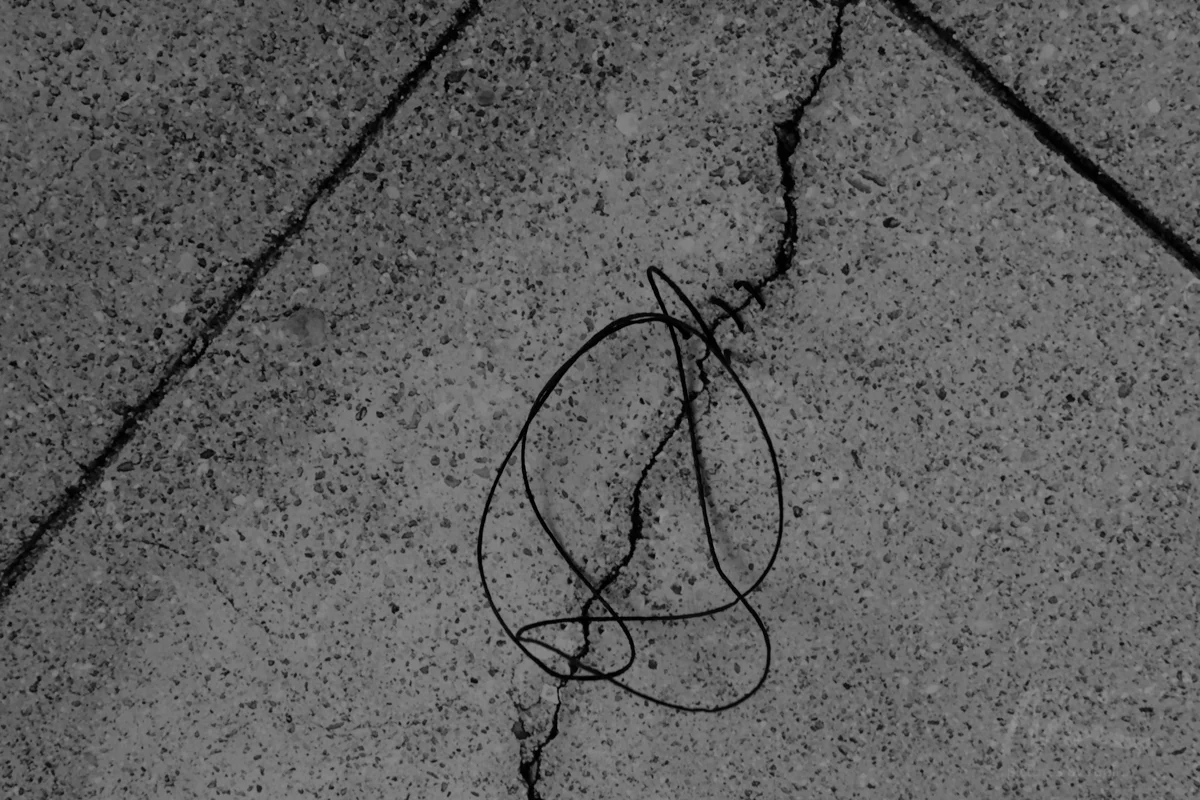


The gesture is simultaneously tikkun olam and kintsugi. The world, even broken, is precious and worthy of reverence, maybe more so. The stitches don't repair the pavement, of course. But perhaps it's not the successful repair that's our obligation, but the act of trying. We heal the world not because the cracks are bad—they are the very essence of humanity—but because it is our job.
Still, my interest isn't in a mixed-media artwork of a sewn-up crack. My interest is in the process of sewing up the cracks. As a photographer, a student of midcentury modernism and Uelsmann surrealism, I began to notice not only the enigmatic nature of what I was doing, but also the classical beauty I saw during the sewing process: the way the thread fell and twisted while I worked, the juxtaposition of the cracks and thread, the way the sun cast shadows.
So I began to photograph the process. The sewing was a means of creating compositions that existed only for a moment, shaped partly by my actions and partly by chance.
On another level, these photographs explore the nature of photographic art and its representation. A photograph that simply documents a mixed-media artwork is one thing. But a photograph of the activity itself, of ephemeral moments of creation, instantaneously beautiful: that's different. These speak to the very heart of the decisive moment.